 Get a Demo
Privileged Access Management
Unify identity and access for humans, machines, & AI.
Zero standing privileges and just-in-time access that accelerates engineering work and transforms resiliency against compromise for your cloud-native, on-premises, and AI infrastructure.

WHY LEGACY PAM FAILS MODERN INFRASTRUCTURE








Break free from vaults and secrets.
Build faster — with greater resiliency.
Teleport unifies trusted identities secured cryptographically, issuing short-lived privileges based on task and context that expire. Shed the operational complexity of secrets, vaults, and bastions and shut down common attack vectors.
 Teleport
| Legacy PAM |
|---|---|
Cryptographic identities replace all static credentials — nothing to steal, lose, or share | Engineers share passwords, SSH keys, and API tokens — hard to rotate, easy to lose |
Just-in-time privileges expire automatically — zero standing access by default | Standing admin access sits open 24/7, massively expanding attack surface |
On-demand access requests approved via Slack, PagerDuty, or automated policy — in seconds | Access requests routed through ticketing tools that move at business speed, not engineering speed |
One unified audit trail across every infrastructure resource, with session recording | Audit logs scattered across Okta, CloudTrail, GitHub — each needing a separate query |
Teleport VNet connects identities to internal resources without VPNs or port forwarding | VPNs and bastion hosts add complexity and create additional attack surface |

OUTCOMES
Reduce operational complexity.

End Credential Sprawl
95%
reduction in exposed credentials and standing privileges
0
shared secrets, static API keys, or vaults to maintain

Speed Up Engineers
10x
faster access provisioning vs. legacy PAM workflows
0
policy violations due to unified identity and access control

Simplify Compliance
100%
auditable sessions across SSH, Kubernetes, databases, and cloud
80%
less audit work with session logs tied directly to identity

Unblock and destress engineers
Eliminate the need for different access paths, passwords, shared secrets, vaults, or VPNs. Break access silos with a unified inventory of all infrastructure resources.
Grant ephemeral privileges and just-in-time (JIT) access using real-time context like role, device, and/or task through the tools your developers trust: CLI, Slack, JIRA, CI/CD, and more.
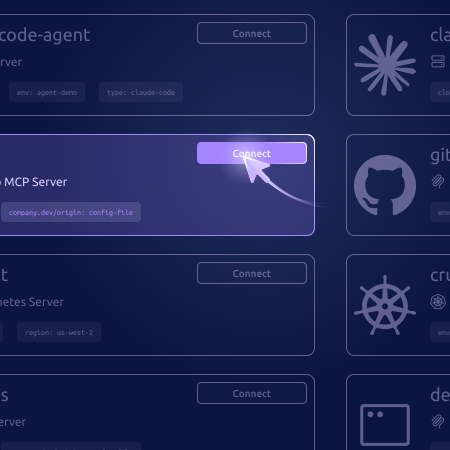

Reduce operational and automation overhead
Streamline the management of your infrastructure with centralized access control across database, server, application, Kubernetes, MCP, RDP, cloud, and GitHub environments.
Remove the need for VPNs and bastion hosts. Deploy automation and new technologies without secrets rotation hurdles.
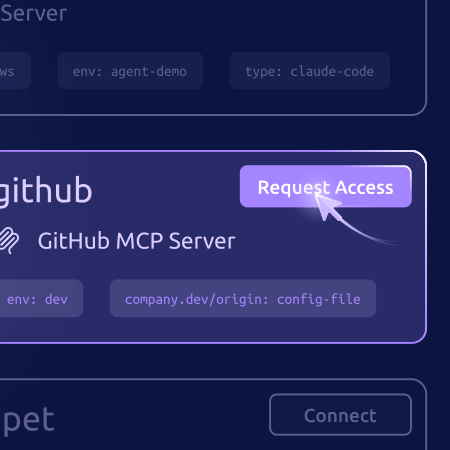

Adopt new technologies
Embrace AI, automation, and infrastructure expansion without policy drift or silos.
Gain unified control over every identity — human, machine, and AI — for consistent authorization, traceability, and Zero Trust as identities and infrastructure expands.
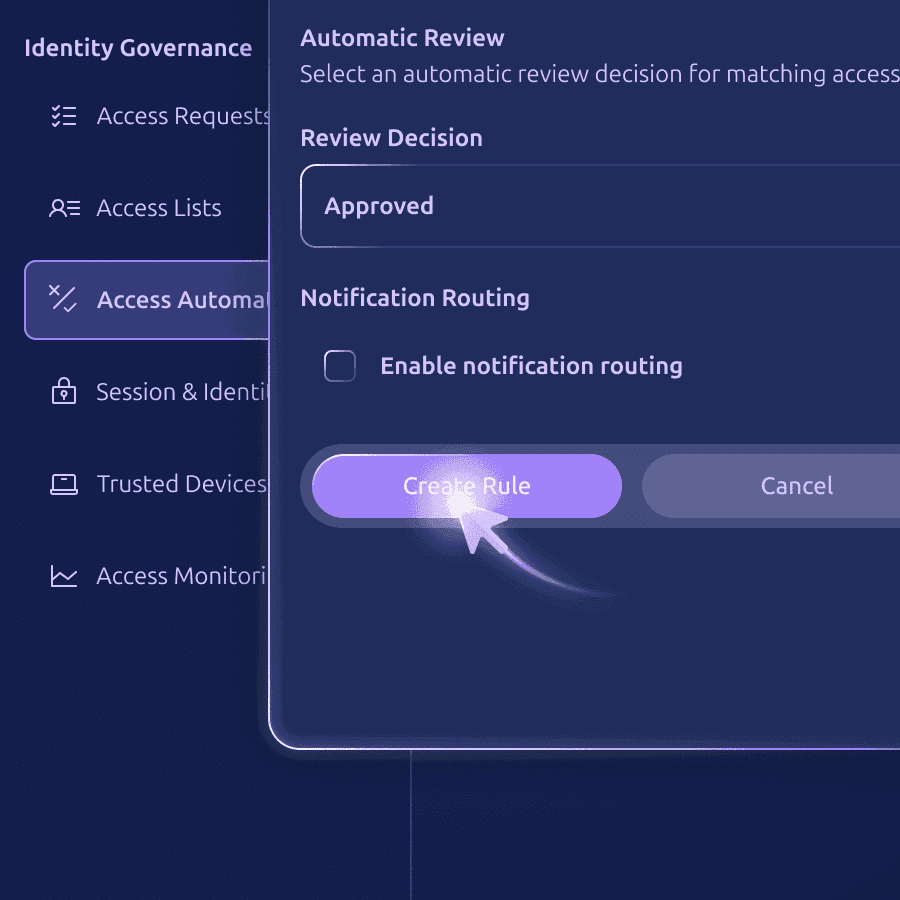

Simplify compliance
Unlock continuous compliance readiness and full identity visibility to simplify audit prep, accelerate incident forensics, and satisfy controls for SOC 2, PCI, ISO 27001, FedRAMP, and more.
Record every privileged session initiated by humans, services, or AI agents for a tamper-proof, searchable log of each command, identity, and action with full context across systems.
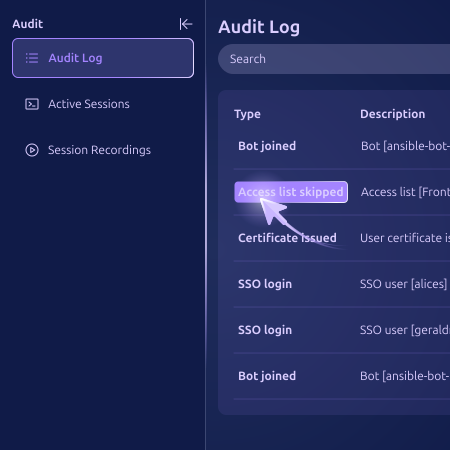
Unify access control and
identity governance.
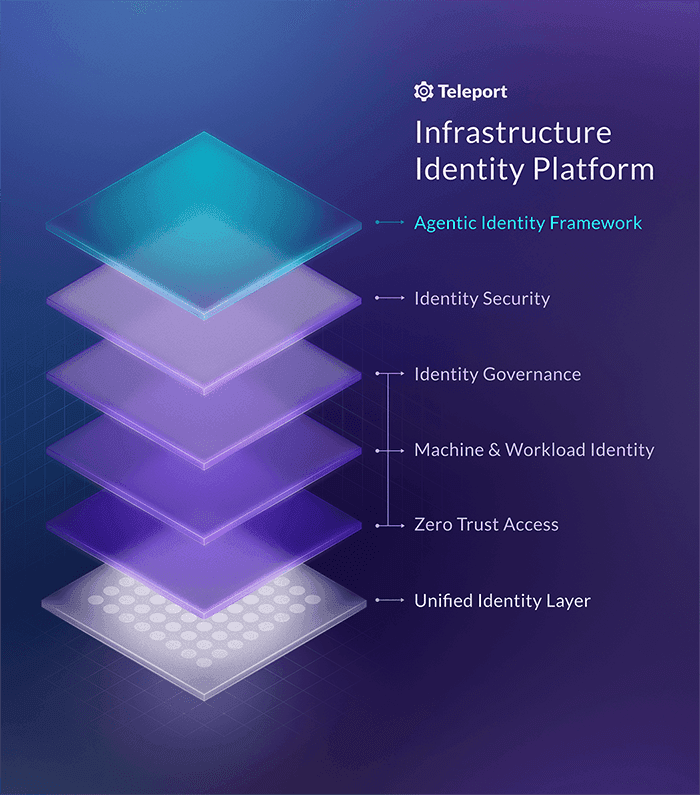
Unify identity governance and identity security with access control — automate governance, lock users, and detect hidden access path risks, for humans, machines, and agents. Restrict access to approved devices, moderate sessions, automate role management with access lists, identify realtime identity risks, and lock identities across all infrastructure.
Key Capabilities

Secretless Authentication
Replace passwords, SSH keys, API tokens, and database credentials with short-lived cryptographic certificates — bound to biometric devices and secure enclaves.

Just-in-Time Access Requests
Engineers request elevated access via Slack, Jira, or PagerDuty. Privileges are granted instantly and expire automatically — no standing access, no cleanup.

Session Recording & Playback
Record every privileged session across SSH, Kubernetes, databases, and cloud consoles. Full playback for incident review, compliance audits, and forensic investigation.

Live Session Visibility
View every active authenticated connection across your entire infrastructure in real time. Terminate sessions or lock identities instantly if needed.

Device Trust
Verify device health and compliance before granting access to sensitive systems. Integrates with Jamf and Microsoft Intune via biometric and hardware-backed credentials.

Compliance Acceleration
Built-in controls for FedRAMP, SOC 2, ISO 27001, HIPAA, PCI DSS 4.0, NIS2, and DORA — with structured audit logs and session recordings ready for auditors.

We used to go through multiple steps just to access cloud resources, and now it happens almost instantly. Our engineers are really happy with the significant improvement in their workflow.
Pradithya Aria Pura
Principal Software Engineer, Container Deployment Platform, GoTo

Ready to Teleport?
DIVE DEEPER


Teleport vs. legacy PAM
Teleport replaces the complexity of vaults and shared secrets with an Infrastructure Identity platform that engineers love and security teams trust.
Feature |  | Legacy PAM software |
|---|---|---|
Credential Handling & Vaulting Manual rotation, storage, and checkout processes | ||
Unified Human, Machine & AI Identity One identity layer for consistent control | ||
Secretless Authentication Identity-based access without shared secrets | ||
Just-in-Time (JIT) Access Identity-based elevations across all resources | ||
Direct Resource Access No proxies, vaults, or middle layers | ||
Identity-Aware Session Visibility All sessions and activity are tied to real identity | ||
AI Session Insights Summaries and analysis of session logs | ||
Simple Deployment Single binary, cloud-native, agentless setup | ||
Scalable to Everywhere Cloud-native, on-prem, Kubernetes; even air-gapped | ||
Future-Ready for AI Ready to secure agentic and autonomous systems |
Frequently Asked Questions
What infrastructure does Teleport secure remote access to?
Teleport provides zero trust remote access to servers, databases, Kubernetes clusters, cloud consoles (AWS, GCP, Azure), web applications, Windows desktops, and MCP servers without VPNs or static credentials like passwords, keys, or tokens. Access is granted through short-lived certificates bound to identity, enabling detailed session recordings and audit events across all infrastructure resources.
Is Teleport a Zero Trust PAM solution?
Teleport replaces static credentials with short-lived, identity-bound X.509 certificates issued per session, enforcing identity verification, authorization, and least privilege on every connection with zero standing access by default. Just-in-time access requests, device trust, and role-based access controls ensure that access is both temporary and traceable.
Does Teleport provide credential vaulting or password rotation?
Teleport is designed to eliminate the use for credential vaulting, password rotation, or secrets management tools and processes. Instead, Teleport authenticates users, machines, and agents using short-lived X.509 certificates that are tied to hardware-backed cryptographic identities. This eliminates the overhead and vulnerabilities associated with large amounts of stored passwords, tokens, SSH or API keys, and database credentials.
What does Teleport replace static credentials with?
Teleport replaces passwords, SSH keys, API tokens, and database credentials with short-lived X.509 certificates bound to verified human, machine, and agent identity. Certificates are issued per session and automatically expire when the task is complete. The tbot agent extends this to machines, CI/CD pipelines, and AI agents, eliminating secrets rotation and vault dependencies.
How does Teleport provide just-in-time (JIT) access?
Teleport's access request system allows users to request access to a role or resource on demand, with a configurable number of approvers required to grant or deny the request and a defined expiration for elevated privileges. Access request plugins integrate with Slack, PagerDuty, Jira, ServiceNow, and other platforms so reviewers can approve or deny requests from existing workflows.
How are access lists managed and reviewed?
Access lists map groups to Teleport roles with defined membership, owners, eligibility rules, and time-boxed enrollment, and requires periodic reviews on a configurable schedule. Owners control membership, and Teleport maintains a record of who had access and why.
How does dual authorization work for sensitive actions?
Teleport's access request system supports requiring multiple approvers before elevated privileges are granted. Request approvers are configurable with limited cluster access so they are not targets themselves.
How does Teleport handle break-glass emergency access?
Access request plugins can auto-approve requests when a user is on call. For example, the PagerDuty plugin grants elevated privileges to on-call responders without requiring permanent admin accounts. Access monitoring rules can also auto-approve requests based on conditions such as schedule, role, or request reason.
Does Teleport work with my existing identity provider?
Teleport integrates with your preferred IdP, including AWS IAM Identity Center, Okta, Microsoft Entra ID, and SailPoint to sync groups to roles. Teleport can also run as an identity provider, issuing short-lived credentials and federating access to downstream apps and services.
Does Teleport work across multiple clouds and clusters?
Teleport supports AWS, Azure, GCP, private clouds, on-premises data centers, and air-gapped environments from one control plane. Trusted clusters federate access across root and leaf clusters — each with its own roles, users, and resources — while users, machines, and agents authenticate with one identity.