 Get a Demo
Agentic AI
Contain and control your
AI infrastructure.
GPU clouds. Kubernetes clusters. Model registries. Agentic workflows. Teleport gives every user, machine, and agent a cryptographic identity and governed access path — so you can build and scale with full control.
WHY UNCONTROLLED AI IS AN IDENTITY CRISIS








AI without identity is
infrastructure without locks.
Most organizations are already deploying AI agents in production, but without a way to govern them. Static secrets, shared service accounts, and legacy IAM were never designed for autonomous, always-on, non-deterministic systems.
 | Traditional Access Models |
|---|---|
Teleport treats every actor — engineers, machines, LLM tools, AI agents, MCP servers, and digital twins — as a first-class identity. The same cryptographic identity model. The same access controls. The same audit trail. No secrets, API keys, or over privileged accounts. | When agents impersonate users, share API keys, and operate without audit trails, you don't have AI infrastructure. You have uncontrolled automation with broad access to your most sensitive systems. |

OUTCOMES
Gain visibility and control

Contain and Control AI
100%
auditable agentic workflow for every prompt, query, and tool call
0
anonymous AI actors in your infrastructure

Reduce Incident Risk
4.5×
fewer security incidents when agents are least privileged vs. over-privileged
0
standing privileges for any AI agent or MCP tool

Accelerate Engineers
80%
drop in time spent troubleshooting infrastructure access issues
0
time wrangling IAM, secrets, or access paths for new AI workloads

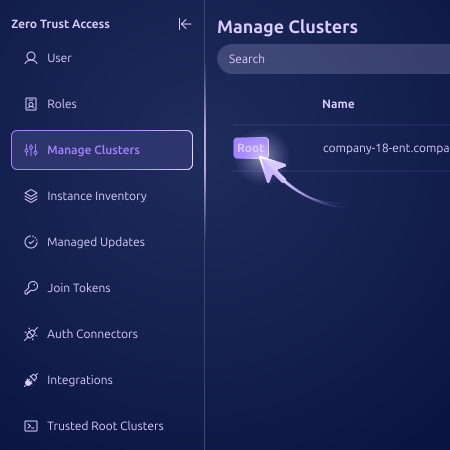
Identity and Access Control
Zero trust controls for every AI workload.
Teleport provides identity-first access, governance, security, and model protection for AI infrastructure — purpose-built for the extreme resiliency, automation, and scale requirements of modern AI workloads.
Zero trust access to GPU clusters, Kubernetes environments, databases, and cloud consoles
JIT elevation for destructive or privileged actions against model registries, S3, MLFlow, HuggingFace-compatible registries
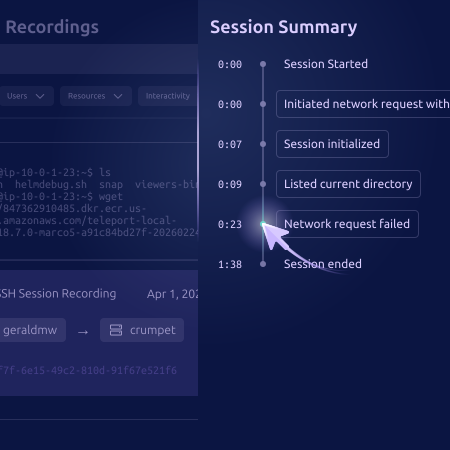
Session recording and interactive session controls for prompt engineering, model training, and agentic AI access
Identity-based, policy-driven access unifying humans, machines, workloads, and AI — no static credentials, no standing access

Model Protection
Lock down your valuable models.
Proprietary models are among a company's most sensitive assets. Teleport protects models with identity-first access and governance — from training data to inference endpoints — without inspecting the model artifacts themselves.
Implement JIT elevation for destructive or privileged actions to MLFlow, S3, GCS, HuggingFace-compatible registries
Embed policy and auditing on access events to databases and cloud services with training data and feature stores
Detect anomalous access and behavior patterns to models with Identity chain mapping across infra, cloud, CI, and agents
Compress forensic investigation with AI-generated incident narratives — know what happened, who did it, and what to check next

Agentic Identity Framework
Leverage the Agentic Identity Framework.
The Teleport Agentic Identity Framework is a standards-driven set of designs, SDKs, and reference implementations that gives organizations a clear roadmap for deploying agentic AI securely.
Establish strong identity with no shared secrets for each agent
Preserve authorization workflows when agents operate as a delegate on behalf of principals
Enforce least-privileged access to services, databases, and infrastructure
Govern agents and MCP endpoints with an audit log for every prompt, query, and tool call
Teleport Beams — Trusted ephemeral Runtimes for infrastructure agents
Run agents securely against real infrastructure.
Isolated. Ephemeral. Connected.
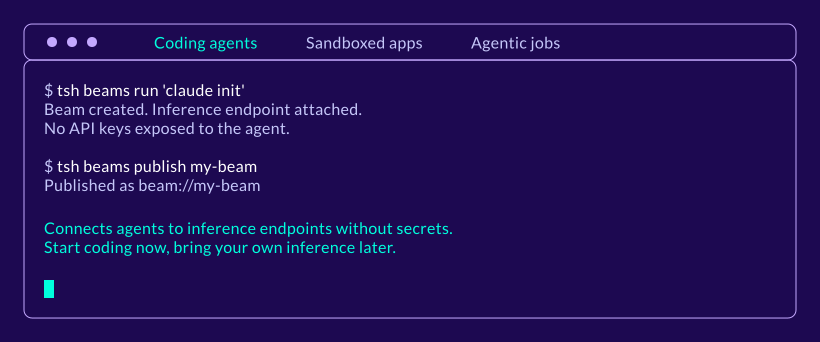
Beams removes the complexity of launching agents — no more stitching together IAM, infrastructure, and secrets by hand. Each agent runs in an isolated VM with delegated identity already connected to your infrastructure and inference endpoints. Fast startup. Zero credentials or keys. Full audit trails.
Beta launching April 30
Secure AI infrastructure at scale
Teleport is the identity platform of choice for AI leaders, from hyperscalers to startups.
Teleport delivers the identity substrate for AI infrastructure and workloads, and operates at the pace and scale to protect high-velocity environments with massive automation footprints.

AI ecosystem integrations
GPU clusters (on-prem, cloud)
Kubernetes, Ray, Airflow, Flyte, Sagemaker
Feature stores and model registries
CI/CD and MLOps pipelines
MCP tooling ecosystems
AI agent frameworks
Sagemaker

Built for AI scale
Tens of thousands of identities
Multi-cloud GPU operations
High-throughput certificate issuance
Zero-static-secret operation
Identity-level resiliency
Near-zero overhead on workloads
Low latency

Hardcore resiliency
Identity and access for agentic AI, MCP, and digital twins
Model, data, and pipeline protection
AI inside the product: summaries, governance assist, anomaly surfacing
Unified identity across humans, machines, workloads, and agents
Zero-trust access across all AI infrastructure resources

Teleport is a leading innovator in identity-based security for managing infrastructure, cloud, and AI access, offering a unified platform for human and machine users and an Agentic Identity Framework for securing AI agents. Teleport's real-time 'chain of custody' offers a unique opinionated approach to identity security that helps customers navigate AI adoption complexities.
Scott Raynovich
Founder & Principal Analyst, Futuriom


Frequently Asked Questions
How does Teleport secure my AI infrastructure and GPU clusters?
Teleport applies Zero Trust Access controls to the infrastructure that runs AI workloads to ensure all connections use strong identity and policy, including SSH nodes, Kubernetes clusters, databases, and MCP servers.
Can Teleport protect my proprietary models and checkpoints?
Yes; Teleport protects model infrastructure by governing and auditing access to the databases, storage systems, and MCP servers that serve those models, not by inspecting the model artifacts themselves.
Does Teleport help secure my training data and feature stores?
Yes; Teleport secures training data and feature stores by enforcing identity-based access and logging on the databases and cloud services that hold your data, enabling visualization of and alerting on risky access patterns.
Does Teleport provide identities to AI agents and digital twins?
Teleport treats AI agents as distinct identities, issuing short-lived credentials and governing them using the same policy and access control framework used to govern human and machine identities.
What is Teleport Beams, and how does it differ from running agents in containers?
Beams provisions an isolated Firecracker VM on EKS, injects a short-lived identity certificate, and opens a VNet tunnel before the agent executes its first line, providing hardware-level isolation rather than container-level.
How does Teleport secure MCP server access connections?
Teleport secures MCP server access by proxying MCP connections between the client and the MCP server via the Application Service, applying RBAC such as tool filtering, and logging all MCP protocol requests as audit events while supporting stdio, SSE, and streamable-HTTP transports.
What does Teleport detect as anomalous in agent and MCP infrastructure access?
Teleport continuously analyzes identity behavior across infrastructure to detect privilege escalation, lateral movement, and other high-risk behaviors, correlating and alerting on more than 50 identity vulnerability types. These detections occur at the identity and access layer rather than the model or data layer.
How does an AI agent get its initial identity from Teleport?
Teleport Machine & Workload Identity leverages Teleport's token resource, supporting both single-use ephemeral tokens and dynamic join methods that use platform-signed identity documents. This includes identities from AWS, GCP, Azure, Kubernetes, GitHub Actions, GitLab CI, and other providers.
What does the Agentic Identity Framework include?
The Teleport Agentic Identity Framework is an evolving architecture framework which includes MCP access proxying, MCP server discovery, LLM controls including rate limiting, budgeting, model routing, and prompt/response tracking, along with audit trails and behavior analysis for agent actions.
Can I restrict which tools an agent can call on an MCP server?
Teleport provides granular role-based access control (RBAC) for MCP. Role resource includes an mcp.tools field, where each entry can be a literal string, a glob pattern, or a regular expression.