 Get a Demo
TELEPORT INFRASTRUCTURE IDENTITY PLATFORM
The future is trusted computing.


Trusted by Market Leaders








Infrastructure needs security at scale
Infrastructure is changing all the time.
Resources are being spun up and destroyed, new technologies are being added, engineers are deploying
automated processes... and need access themselves.

Transform infrastructure to trusted computing environments, hardening security and removing obstacles and inefficiency for engineers.
Protect your core systems and data, thwarting threat exploits and reducing the operational complexity of network- and credential-centered security.
Eliminate the persistent risk that digital credentials, standing privileges, static credentials, and network perimeters embed in your datacenter and clouds.

The intricacies of modern infrastructure demand more robust security solutions. Infrastructure Identity is a compelling approach to this challenge.

Stephanie Walter, Analyst-in-Residence, HyperFRAME Research
Establishes strong identity
Protects identities from misuse, loss, or theft
Identities are a preferred target of threat actors because when they are represented digitally, they can be shared, lost or stolen. Infrastructure is littered with static credentials, governed by passwords, tokens, API keys, SSH keys, and more.
Managing this landscape of credentials not only introduces risk but also becomes a huge operational headache for the engineers using them to bridge access to do their work.
Infrastructure Identity are cryptographically secured, with all identities whether human, machine, workload or AI, bound to physical-world elements such as biometrics, secure enclaves, or a root of trust pinned to trusted hardware.

Before Infrastructure Identity
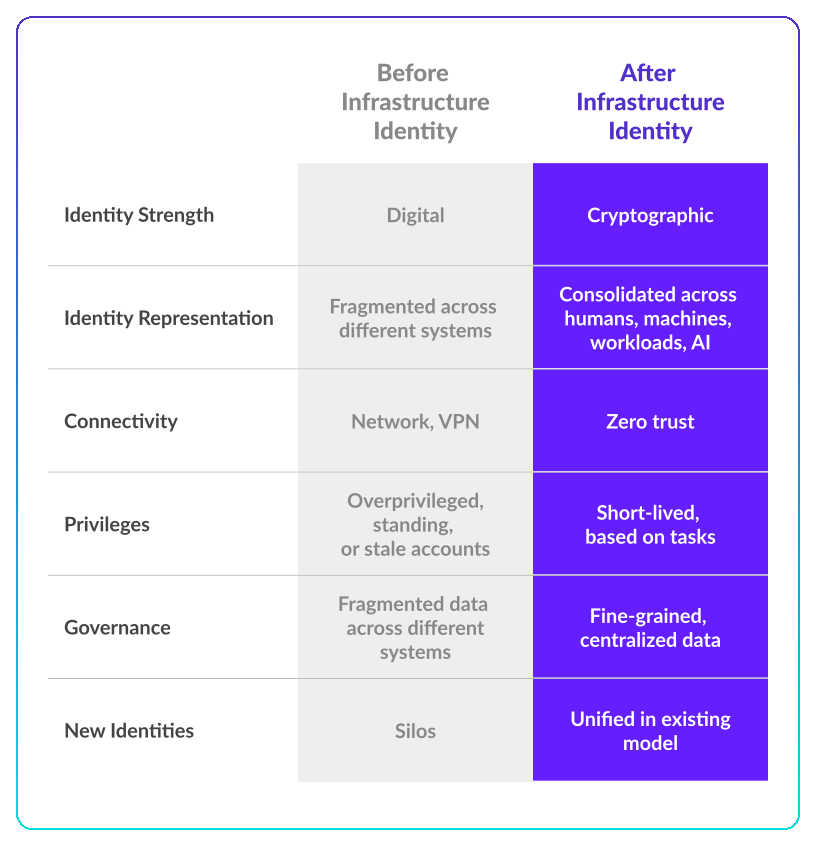
Infrastructure is littered with static credentials, many of which are overprivileges and unmanaged and which can be shared, lost, and stolen.
After Infrastructure Identity
All identities, whether human, machine, workload or AI, are cryptographically secured to physical-world attributes, with no standing privileges.
Consolidates identities
Consolidated view informs policy
When all trusted identities are consolidated into a unified view,
they can be considered together for proper reasoning about policy.
This enables companies to enforce policies such as "AI agents should not have access to production customer data" or "Level 1 engineers should not be able to use LLMs to access production customer data.
Before Infrastructure Identity
Identities are represented differently across management, privileged management, and observability systems.
After Infrastructure Identity
All identities are considered together, enabling enforcement of policy across humans, workloads, devices, and AI.
Implements zero trust
Eliminates anonymous computing
Zero trust extends into and through infrastructure, maintaining persistence of identity and protocol.
This transforms infrastructure stacks into full zero trust environments, eliminating complexity of wrangling with VPN setups and making identity your security perimeter.
An added benefit... there are no more identities abstracted as "admin" that obscure attestation.
Before Infrastructure Identity
Network segmentation is cumbersome to manage, while zero trust access usually stops at application authentication.
After Infrastructure Identity
Infrastructure Identity propagates zero trust throughout the infrastructure stack, with identity and protocol persistence.
Enforces task-based policy
Short-lived privileges reduce risk and complexity
Task-based authorization, whether human or machine, reduces attack surface and blast radius by enforcing the security invariant, "No one or nothing should have access unless there is work being performed.
This eliminates complexity around privileges management and streamlines just-in-time access workflows.
Before Infrastructure Identity
Access management and privileges management are separated, often leading to excess and standing privileges.
After Infrastructure Identity
Authorization is based on tasks, reducing the surface area that can be targeted by threat actors exploiting lateral movement.
Establishes source of truth
Streamlines audit and incident response
Fine-grained data capturing who is doing what in your infrastructure streamlines compliance and accelerates forensic investigation and incident response, reducing the audit burden and manual log investigation.
Before Infrastructure Identity
Data is fragmented across systems and is incomplete, impending audit activities and slowing down incident response.
After Infrastructure Identity
Fine-grained, centralized data reduces the audit burden and accelerates investigation and incident response.
Readily extends to new identity types like
AI Agents, LLMs, and MCP servers
Infrastructure leaders are always incorporating new technologies to stay competitive.
Infrastructure Identity extends to incorporate new tech, breaking down security silos that create
fragmentation, overhead, and increase the probability of human error.
Media Spotlight
The New Stack
Cracking the Complexity:
Teleport CEO Pushes Identity-First Security