Make PostgreSQL Access Easier and More Secure with Teleport
Managing PostgreSQL access is a pain for engineering teams. Setting up users, roles, and keeping track of permissions slows down engineers. Security risks may emerge in the form of shared admin accounts or missteps in user setup or authorization workflows.
Check out this screenshot from a Reddit thread discussing this problem. There are tons of questions about how to manage access to PostgreSQL at scale, and unfortunately, many engineers may turn to risky access practices that can inadvertently introduce infrastructure vulnerabilities.
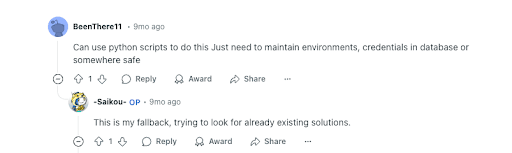
Teleport is a company of engineers — we understand the importance of driving innovation forward. But at the scale and impact of modern AI development projects, there is simply too much at risk to leave room for backdoors and copy + pasted credentials.
The real problems AI teams face with PostgreSQL access
A few months ago we noticed an uptick in AI companies coming to Teleport asking about the same thing — managing access in PostgreSQL at scale in a way that eases operational burdens, reduces the attack surface, and simplifies compliance requirements.
Luckily, the Teleport team has a lot of experience with Automatic User Provisioning in PostgreSQL. There are other benefits that we wanted to take some time to explain, too.
Essentially, companies running AI workloads at scale need to manage privileged access in a way that can actually keep up with the demands of dynamic, ephemeral environments. This is especially important for Kubernetes environments, too.
The real problems AI teams face with PostgreSQL access
1. Too many manual processes for user and role management
AI teams often have different members needing access to PostgreSQL, each with different roles. Setting up and maintaining these manually is time-consuming and prone to errors.
As this user on Reddit puts it:
"Setting up users and roles manually is eating up a lot of time and isn't efficient. I'm looking for a way to streamline this process and make it more manageable for our team without being a hassle for our engineering department."
💡 Teleport’s fix:
Manually managing users and roles in PostgreSQL can be a hefty burden. Teleport integrates directly with your PostgreSQL databases, allowing you to leverage your SSO provider (Okta, Google, Entra ID, etc.) with their permissions scoped to their job function, or specific to the current task at hand. This allows you to manage your access dynamically, removing the need to share usernames and passwords to overprivileged database users.
Here is an example of what it looks like in the wild from the Mirkl tech blog on Medium: Mastering Kubernetes and Database Administration with Teleport and Cloudnative-PG: A Step-by-Step Guide.
2. Shared admin accounts are a security and compliance nightmare
Many teams rely on shared admin accounts for convenience. Security teams and auditors hate this. It quickly becomes impossible to track who did what, in addition to being a forensic and remediation nightmare should that shared account become compromised.
One Reddit user warns:
"You'll get dinged for shared admin accounts for devs if you’re ever audited. Ideally, there’s only one admin account that is ever being touched by humans."
💡 Teleport’s fix:
Just-in-time access with audit logs. Teleport enforces least privileged access, ensuring engineers only get the access they need, when they need it. Every access request, approval, and query is logged in real time, making audits a breeze.
Who says audits can’t be fun! Or, at the very least, they can be less of a headache. Here's a quick six minute video that shows off how easy it is to audit PostgreSQL access with Teleport: Using Teleport to Audit Postgres and MySQL Database Access. Note: while this video is a few years old at this point, and a lot of features have been added since it was recorded, this application still rings true.
3. Static credentials are a massive security risk
Hardcoded passwords, stale API keys, and manually managed credentials are a hacker’s best friend. They get leaked, forgotten, and misused. As infrastructure grows, the business expands, and employees change, these static credentials are vulnerabilities that accumulate exponentially. One Reddit user shared their approach to fixing this:
"We use a secret management tool to rotate credentials and issue dynamic, short-lived secrets instead of static passwords."
While this user’s approach may be deemed acceptable by most, it doesn’t really go far enough for our comfort. Aren’t you still storing and juggling secrets at the end of the day?
💡 Teleport’s fix:
Total elimination of static credentials, secrets, and keys.
There is no need for secrets management tools, because secrets are no longer part of the access chain. That means no more static credentials for infrastructure access. Period.
Instead, Teleport replaces passwords with short-lived certificates that automatically expire, thereby eliminating credential theft risks while making access easier and more effortless for engineers.
4. Scaling PostgreSQL access across complex infrastructure
AI teams often work across cloud, hybrid, and on-prem environments. Managing PostgreSQL access across this complexity is a huge challenge, especially when relying on each environment's tools for controlling access. As PostgreSQL instances grow in size and number, access control and policy enforcement becomes increasingly challenging — eating away at the already limited bandwidth infrastructure teams have. Additionally, many AI development workloads run on Kubernetes or other container orchestration platforms. Ensuring ephemeral containers have secure and auditable database access is a challenge. Security blind spots and fragmented audit logging are all but inevitable without a unified access model.
💡 Teleport’s fix:
Unified access control, across all environments.
Teleport works across all environments, providing a single control plane for secure database access. Whether PostgreSQL instances are in AWS, GCP, on-premises, or containerized in Kubernetes, Teleport makes access effortless — improving both infrastructure resiliency and engineering speed.
Teleport makes it easy to manage and enforce policy across complex and distributed infrastructure, databases, and applications. Access requests are dynamically evaluated based on identity and context — critical for enforcing the principle of least privileged access as infrastructure like container clusters and PostgreSQL databases are scaled up and down.
Why AI teams use Teleport for PostgreSQL access
Teleport delivers a zero trust, identity-first approach to PostgreSQL access, ensuring fast and secure database connectivity without manual headaches.
- No more user management overhead: Connect PostgreSQL to your identity provider and let Teleport handle access dynamically.
- No more shared admin accounts: Enforce just-in-time access with full audit logging.
- No more static credentials: Replace passwords with short-lived cryptographic certificates.
- Works across any infrastructure: Secure access for cloud, hybrid, and on-prem PostgreSQL instances.
- Audit and compliance built-in: Every access event is logged for easy compliance.
Make PostgreSQL access secure, scalable, and effortless
PostgreSQL is an industry standard for storing, managing, and querying large datasets. Why? Reliability, ease-of-use, and stability. Keeping your databases secure at scale should not require compromising on these value-adds by complicating AI development workflows or requiring a ton of manual work.
With Teleport, you can quickly eliminate credential and privilege-related security risks, streamline compliance efforts, and provide engineers and data scientists with secure access at the speed they deserve. AI development teams rely on Teleport to improve and secure PostgreSQL access with unified, just-in-time access across clouds and datacenters based on short-lived certificates — keeping your engineers moving at lightning speed.
This doesn’t stop with PostgreSQL. Explore our complete list of Teleport integrations.
Ready to improve and secure PostgreSQL access?
Get started with Teleport today.
Get Started
Table Of Contents
Teleport Newsletter
Stay up-to-date with the newest Teleport releases by subscribing to our monthly updates.