FIPS 140-2 vs FIPS 140-3, Explained
Table Of Contents
- What is FIPS 140-3?
- When is FIPS 140-3 required?
- The FIPS 140-3 transition timeline
- Key differences between FIPS 140-2 and FIPS 140-3
- What are the FIPS 140-3 levels?
- How to read a real CMVP certificate
- How does FIPS 140-3 affect your infrastructure?
- Deploy a dedicated FIPS build with Teleport
- Frequently asked questions
Read this article to learn:
- Key differences between FIPS 140-2 and FIPS 140-3
- The exact FIPS 140-2 to FIPS 140-3 transition dates, as described by NIST
- How to read a real CMVP certificate
- How FIPS 140-3 affects your infrastructure
What is FIPS 140-3?
FIPS 140-3 is the current standard for validating cryptographic modules, which are the specific hardware or software components that implement encryption and manage keys inside a defined boundary. FIPS 140-3 was approved on March 22, 2019, became effective on September 22, 2019, and supersedes FIPS 140-2, which dates back to 2001.
Most FIPS 140-3 security requirements come from ISO/IEC 19790:2012, with test requirements drawn from ISO/IEC 24759:2025. NIST layers US-specific modifications on top through its SP 800-140x series. This means that 140-3 validation requires testing against an international standard in addition to NIST's amendments, which is in contrast to 140-2's US-only lineage.
FIPS 140-3 validations are issued by the CMVP (the Cryptographic Module Validation Program), run jointly by NIST and Canada's CCCS. An accredited laboratory tests the module, and the CMVP publishes a numbered certificate on the NIST site. That certificate number is the artifact this post revolves around.
When is FIPS 140-3 required?
If cryptography is being used to protect sensitive data in a US federal system, the module doing that cryptography must be FIPS validated. This is extended to FedRAMP for cloud services sold to agencies, and to NIST SP 800-171 for defense contractors handling controlled unclassified information. In all of these circumstances, FIPS validation requires earning a CMVP certificate.
The FIPS 140-3 transition timeline
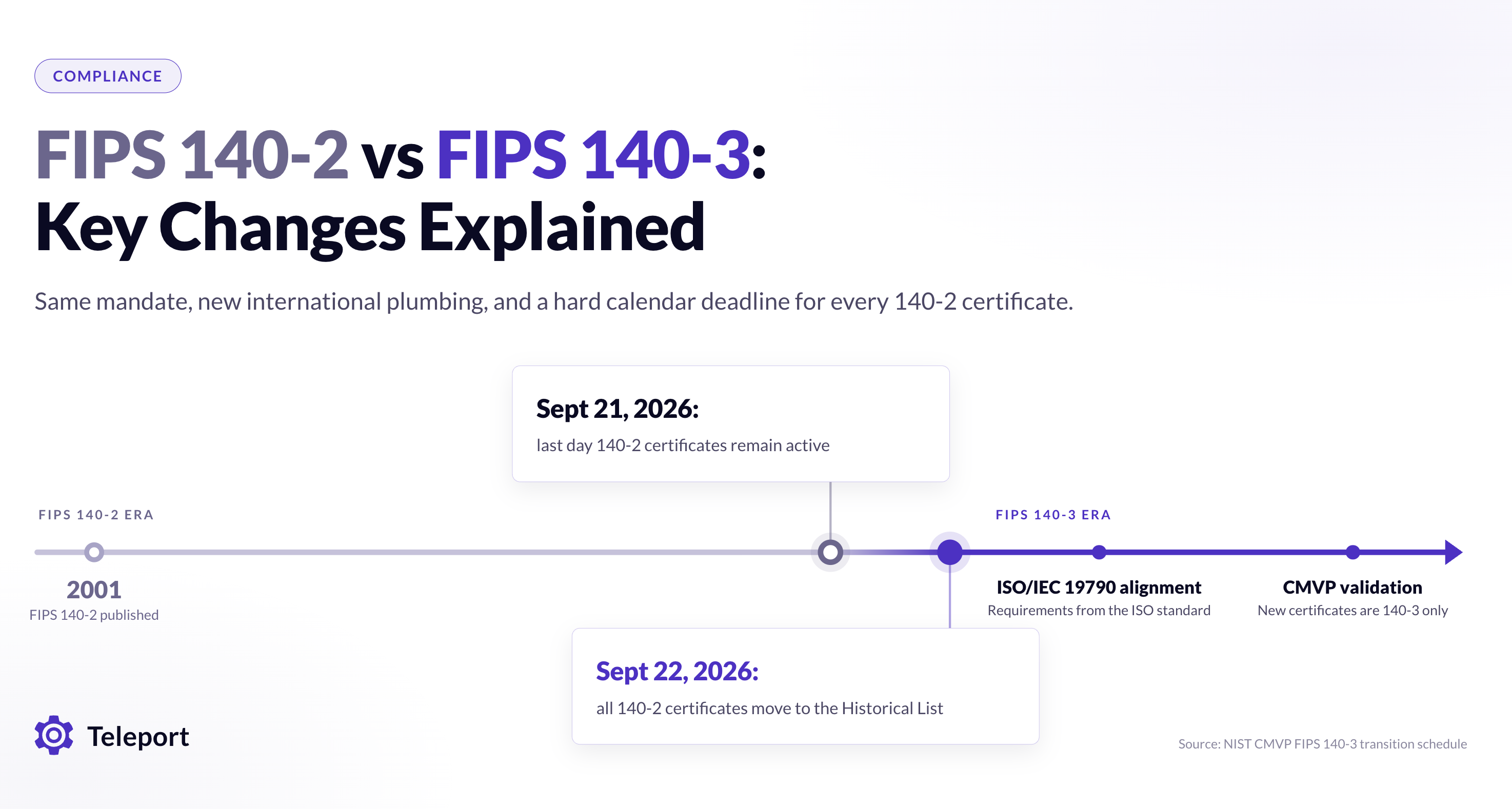
Here’s the FIPS 140-2 to 140-3 transition timeline from NIST:
- September 22, 2019: FIPS 140-3 became effective.
- September 22, 2020: The CMVP started accepting 140-3 submissions.
- September 22, 2021: The primary cutoff for new 140-2 submissions. An extension path for labs ran until April 1, 2022.
- September 21, 2026: The last day any FIPS 140-2 certificate is Active.
- September 22, 2026: All FIPS 140-2 certificates are placed on the Historical List.
Those last two dates (September 21 and September 22) may look like typos until you read the page carefully. Regarding the continuation of FIPS 140, the section says this:
“FIPS 140-2 modules can remain active for 5 years after validation or until September 21, 2026, when the FIPS 140-2 validations will be moved to the historical list. Even on the historical list, CMVP supports the purchase and use of these modules for existing systems.”
The transition schedule table on the same page has a final row dated September 22, 2026:
"All FIPS 140-2 certificates are placed on the Historical List."
The defensible interpretation is that September 21 is the last Active day of FIPS 140-2, and September 22 is the day the move takes effect. Still, this row is frequently misunderstood. Many vendor FAQs may answer "no" to whether Historical modules can still be used.
However, NIST's own wording supports continued purchase and use for existing systems. What Historical status blocks is procurement for new systems; the residual risk decision rests with the agency. This is the most important point to remember from this post.
Key differences between FIPS 140-2 and FIPS 140-3
Here is a comparison of the main differences between 140-2 and 140-3, followed by the changes I think practitioners should pay special attention to:
| Area | FIPS 140-2 | FIPS 140-3 |
|---|---|---|
| Source documents | Standalone US standard (2001) | ISO/IEC 19790:2012 plus ISO/IEC 24759:2025, with NIST SP 800-140x modifications |
| Requirement structure | Its own requirement areas | Eleven areas following ISO/IEC 19790:2012 Section 7 |
| Protected parameters | CSPs (critical security parameters) | SSPs (critical plus public security parameters) |
| Self-tests | Up front, before service | Pre-operational integrity tests plus conditional tests; some algorithm tests deferrable |
| Non-invasive attacks | No dedicated requirements | Required area, tested at higher levels |
| Behavior after a failure | No degraded mode | Degraded operation permitted, under conditions |
| Approved-service visibility | Not required | Service indicator required |
| Security levels | 1 to 4 | 1 to 4, retained |
The major changes to understand are as follows:
- CSP becomes SSP: 140-2 protected critical security parameters, essentially keys and secrets. 140-3's sensitive security parameter covers those and public security parameters, broadening the set of parameters a module must formally manage.
- **Non-invasive attack requirements: Side-channel techniques like power analysis and timing analysis now have their own requirements, with lab testing at the higher levels.
- Self-tests were restructured: A 140-3 module runs pre-operational self-tests (integrity checks before first use) plus conditional self-tests (triggered by specific events), and it can defer some algorithm self-tests. Anyone who has watched a module grind through power-on tests will appreciate this.
- Degraded operation mode: A module that hits a failure may keep offering its unaffected services under certain conditions. With 140-2, there was no sanctioned way to do this.
- Service indicators: A 140-3 module must be able to indicate when a service is using an approved security function. For vendors, it is a real operational change, because "are we in approved mode right now?" becomes an answerable question.
- Additional changes to note: 140-3 also brings a trusted channel concept for moving sensitive parameters, hybrid module types that combine software and hardware, and a life-cycle assurance area.
What are the FIPS 140-3 levels?
All four security levels from 140-2 survived the transition. Like 140-2, each security level builds on the level preceding it:
- Level 1: Correct implementation. Approved algorithms are tested inside a defined cryptographic boundary.
- Level 2: Tamper evidence (you can tell someone got in) and role-based authentication.
- Level 3: Tamper resistance (getting in is hard), identity-based authentication, and environmental failure protection and testing.
- Level 4: Tamper detection-and-response envelope, multi-factor identity-based authentication, and fault injection mitigation.
Levels 2 through 4 are mostly about physical protections and stronger operator authentication. This is why hardware security modules chase them while software libraries generally do not. It’s also important to note that Level 1 software validation, while the first security level, is still important. In fact, it’s the typical shape for a crypto library.
How to read a real CMVP certificate
Let's read a CMVP certificate together. CMVP certificate #5247 covers the Go Cryptographic Module, the native FIPS module for the Go language.
Here is how to read this entry:
- Certificate #: The number that proves validation.
- Module name - Go Cryptographic Module: Only the cryptographic module is validated in its approved mode. This does not extend to the Go language or every Go program.
- Standard - FIPS 140-3: Some entries in the CMVP database are still 140-2 validations.
- Status - Active: Active counts for new procurement. Historical means existing systems only.
- Sunset date - 4/26/2031: Validations are valid for five years . In this case, the initial validation here was 4/27/2026.
- Overall Level 1: A software module, per the section above.
- Vendor: The organization that maintains the module.
- Validation history: Because validation requires third-party testing, the validating lab is listed alongside the initial validation date.
By spending a few minutes reading a vendor’s CMVP certificate, you will know more about a vendor's FIPS story than a data sheet will tell you. However, it’s important to note that a certificate covers the cryptographic module being used, not the product itself.
How does FIPS 140-3 affect your infrastructure?
Most organizations are not building cryptographic modules themselves, nor taking those modules through validation. However, organizations are far more likely to embed validated modules within the products and services they are building.
This requires you to inventory every product and service in your stack that is associated with FIPS, which can be a very manual and time-intensive exercise. Then, the module and certificate number need to be actualized and verified.
Deploy a dedicated FIPS build with Teleport
If your infrastructure identity and access layer needs to run on validated cryptography, Teleport Enterprise ships dedicated FIPS builds.
- Review Teleport’s FedRAMP documentation to learn how FIPS builds fit your compliance requirements.
- Test a FIPS-validated build in your own environment with a Teleport Enterprise trial.
- Learn how to automate identity and access for FedRAMP 20x KSIs.

Mayur Pipaliya
Mayur Pipaliya (MP) is known for his expertise in trusted computing and identity-first infrastructure for hybrid cloud and AI. Across 19+ years, he has charted a trailblazing path, from being an accidental entrepreneur running a data center company in the pre-cloud era to founding Splunk's Global Forward Deployed Software Engineering (FDSE) team and leading platform engineering, DevRel/DX, CNCF OTel open source, and AI/ML marketplace functions that helped scale data products to $4B in revenue. MP advises enterprises on modernizing data centers and multi-cloud, multi-agent strategy, and volunteers with DEFCON, OWASP, null Security, Columbia's Justice Through Code, and Habitat for Humanity. When not firefighting, he loves trail running and biking in the Bay Area.
Frequently asked questions
What does FIPS compliance require?
What is the difference between FIPS 140-2 and FIPS 140-3?
Does Teleport support FIPS 140-3?
How does Teleport support FIPS and FedRAMP requirements?
Table Of Contents
- What is FIPS 140-3?
- When is FIPS 140-3 required?
- The FIPS 140-3 transition timeline
- Key differences between FIPS 140-2 and FIPS 140-3
- What are the FIPS 140-3 levels?
- How to read a real CMVP certificate
- How does FIPS 140-3 affect your infrastructure?
- Deploy a dedicated FIPS build with Teleport
- Frequently asked questions
Teleport Newsletter
Stay up-to-date with the newest Teleport releases by subscribing to our monthly updates.
Tags
Tags
Teleport Newsletter
Stay up-to-date with the newest Teleport releases by subscribing to our monthly updates.
Related Articles
Certificate-Based Authentication Best Practices
We explain security best practices for both developers and administrators of certificate-based authentication, focusing on infrastructure access.
2026 Research: The Top AI Infrastructure Risks and Identity Gaps
New Teleport research examines rising AI infrastructure security risks, adoption trends, and the identity controls reducing incident rates in 2026 and beyond.
How to Apply NIST 800-53 to AI Systems
Learn to apply NIST 800-53 to agentic systems and AI infrastructure with control guidance on identity, auditing, configuration management, and monitoring.